Channel 4: The Robot Will See You Now
An emotive face, and the communications behind it, for a robot on Channel 4
Reflex Arc is a UK studio that builds real-time and AI-driven experiences - conversational characters, robots, and the software that makes them feel immediate. This is one of our earliest robotics projects.
Client: Double Act Productions, for Channel 4
Broadcast: Channel 4, 28 November 2017, as part of the Rise of the Robots season
What we built: The face - the robot's expressions, its "listening" and "thinking" states, and the communications layer that drove it in the room - running on an Android device
In short
The Robot Will See You Now put a robot called Jess in a room with real couples and families, and asked whether people would open up to a machine. For that to work at all, Jess had to be someone you could read: attentive when you spoke, visibly considering what you'd said, and able to react. We designed and built that face, and the system that told it what to feel.
Making a machine readable
A robot that's meant to be weighing up a conversation is only half the job. If the people in front of it can't tell whether it's listening, whether it's understood, or how it's taking what they've just said, the exchange collapses - they talk to the camera, or to each other, and the robot becomes furniture.
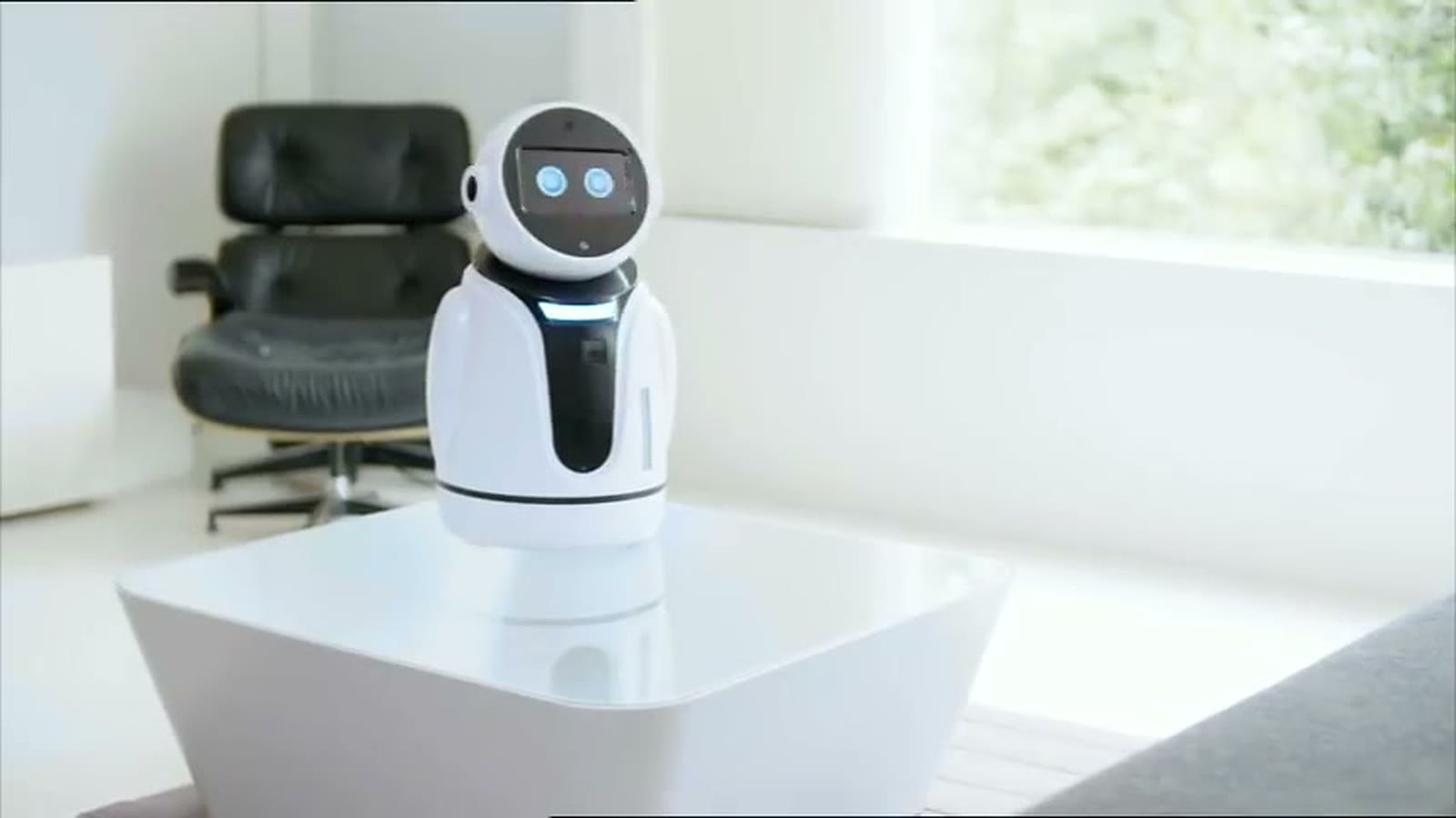
Jess, on set. The head is a shell around an Android device; what's on the screen is ours.
Jess's face was our answer to that. A deliberately simple, expressive design - eyes that could hold your gaze, an idle state that felt present rather than switched off - running on an Android device inside the robot's head. It didn't try to be human; it tried to be legible.
The face had a small vocabulary of states, and the whole thing rested on the transitions between them feeling right on camera:
- Idle
- Listening
- Thinking
- Analysing
- Talking
- Smile
- Heart
- Rage
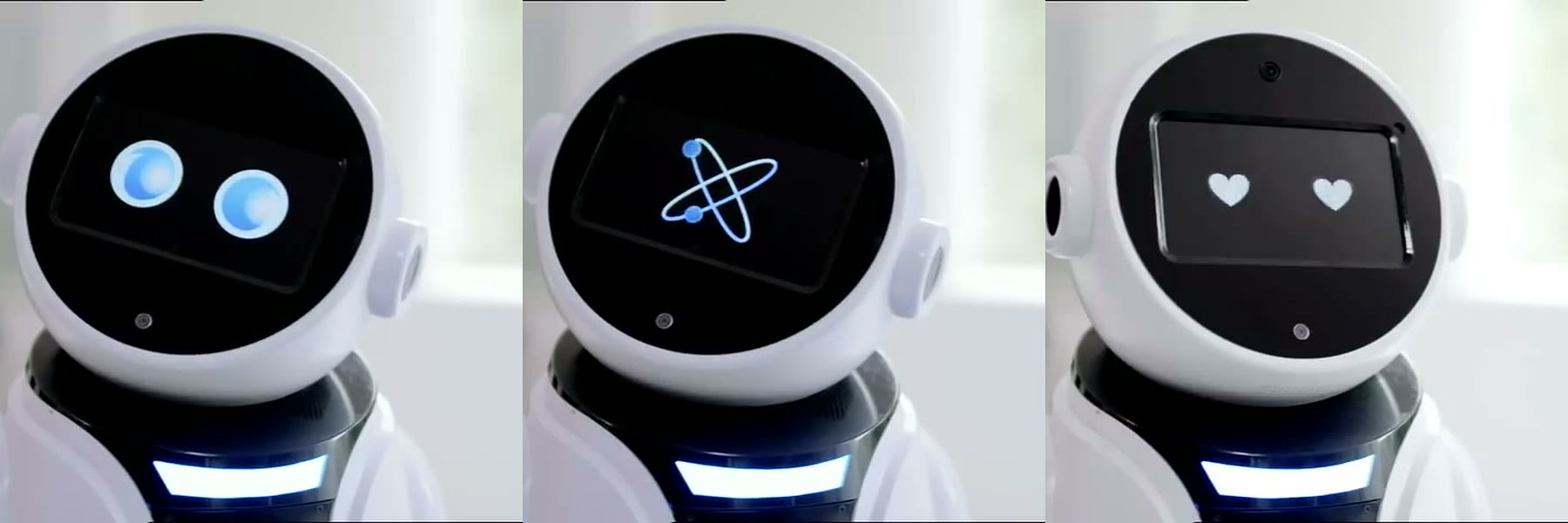
Listening, thinking, and - when the moment called for it - hearts. The loop at the top of the page shows the transitions between them.
How it was driven
The face wasn't a looping animation. Behind it sat a communications layer that decided what Jess should show at any moment - some of it automated, some of it a human in the loop with a production-side control app, cueing what the conversation called for. How much was which is the programme's business, not ours. What we will say is that this was 2017: the tools of the day could pick out keywords and sentiment, not follow what someone was actually saying, and what made Jess convincing was design and timing rather than intelligence.
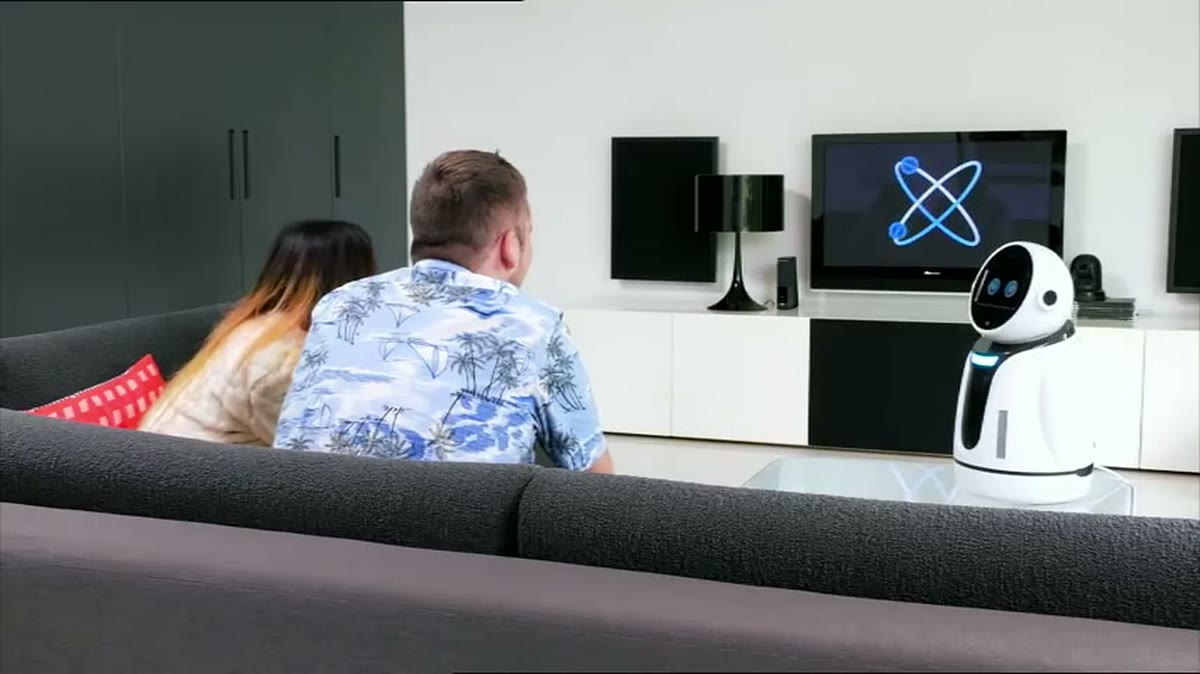
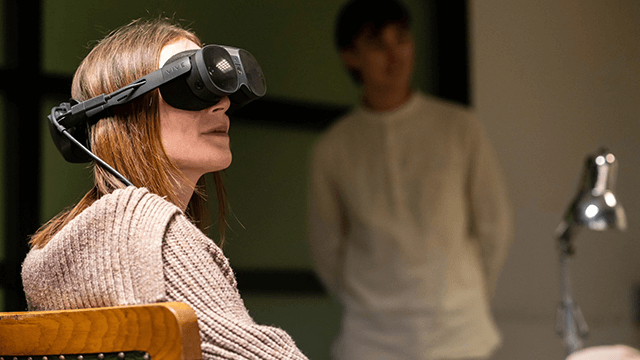
In the room. What Jess was "thinking" was mirrored on the screen behind her, so the couple - and the audience - could see it too.
What we can say: the interesting problem wasn't the artwork, it was latency and timing. A face that reacts half a second late reads as vacant; one that reacts too early reads as scripted. Getting the loop from a cue to a change of expression short and reliable, across a network, on a consumer Android device in a lit studio, was the real work.
The same problem, eight years later
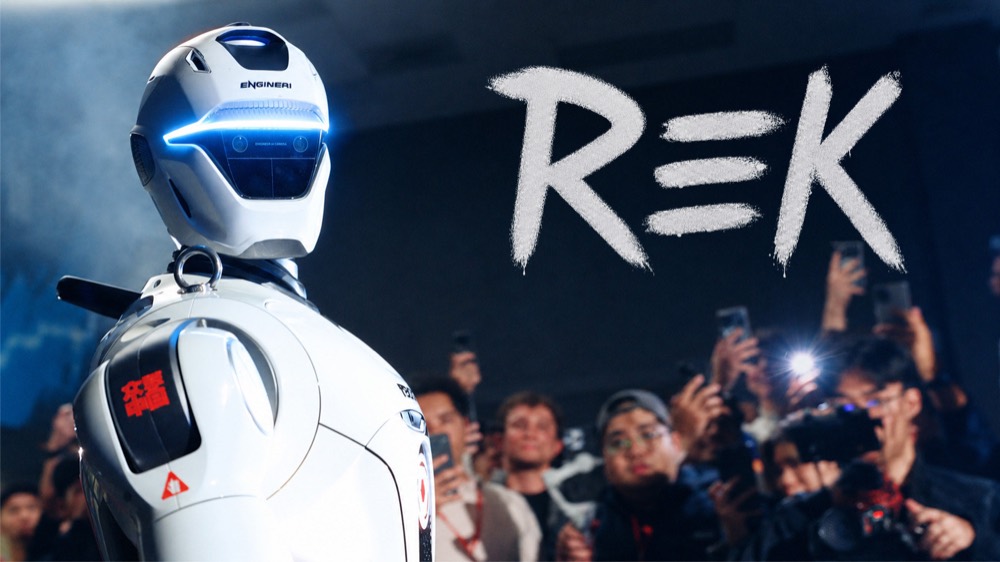
This was our first robot face. In 2025 we started work on REK - full-size humanoids piloted live in VR in front of a crowd - and the core challenge turned out to be the one we'd met with Jess: closing the gap between an intent and a machine's response so tightly that the response feels like it belongs to the machine. Jess needed to look like she was listening. A REK robot needs to look like it meant that punch. It's a different scale of body, and the same reflex arc.
Watch
The programme aired on Channel 4 and has been available on its streaming service in the UK. Trailer below.
Robotics expertise on the programme came from Prof. Tony Belpaeme (Plymouth) and Dr Caroline Jay (Manchester), among others. Directed by Tom Fulford. Images are stills from Channel 4's trailer, © Double Act Productions / Channel 4. Our role was the face and its communications - everything else you see is theirs.
Putting a face on something?
A companion, a care robot, a kiosk, a character in a car or a headset - if people are going to talk to it, they need to be able to read it. We've been working on that since 2017 - and the part that was smoke and mirrors then is real now: real-time voice, a language model that actually listens, and a body or device it has to hold up on. Tell us what you're building.