LivingBodiesObjects: VR without the visuals
Immersive technology advisors to a £1m Wellcome Trust research project – and the experience that launched it
Client: LivingBodiesObjects, University of Leeds
Our part: Immersive technology advisors across the three-year project; designed and built the launch experience
Funder: Wellcome Trust – Research Development Award, £1m over three years
With: Immersive Networks; concept developed in partnership with Tom Jackson, who led the project and recorded the audio
When: May 2022
In a sentence
For the launch of LivingBodiesObjects, we built an interactive spatial audio experience – VR without the visuals: the outline of a body laid out across the floor, and visitors in position-tracked headphones walking through it, hearing a different part of the body's sound world at every step – then a dancer whose movement drove the sound for the whole room.
The project
LivingBodiesObjects (one word, though often written Living Bodies Objects) – Technology and the Spaces of Health – is a £1 million, three-year Wellcome Trust Research Development Award at the University of Leeds led by Professor Stuart Murray, one of the largest medical humanities awards the university has received. It asks how health research is done – who decides where to start, what counts as evidence, whose bodies are in the room – and it deliberately tests the boundaries of the discipline: researchers working with artists, clinicians and the public through six-month residencies with the Thackray Museum of Medicine, Interplay Theatre, Blueberry Academy and the Bhopal Medical Appeal, with outputs ranging from theatre and podcasts to a six-month museum exhibition.
For the project's launch in May 2022 the team wanted something visitors would do rather than watch – an experience that put the project's questions about bodies, senses and technology into practice in the room itself.
Advising a Wellcome Trust research lab on immersive technology
LivingBodiesObjects describes its lab as starting "not from specific research questions about health and technology, but from a space of experimentation and curiosity" – a lab that is "virtual and mobile as well as a physical space", and that sets out to value "embodied knowledge" and "lived experience" alongside academic ways of knowing.
"Our creative partners on the LivingBodiesObjects project, part of our core team… an award-winning alliance of artists, scientists, and technologists [who] help translate complex information into actionable understanding using immersive technologies."
LivingBodiesObjects, on Immersive Networks – the collective Reflex Arc worked within on the project
Reflex Arc's involvement ran through the project as consultants on immersive input and output: how a body's movement, touch, position and voice can be sensed and used; how sound, image, haptics and space can answer back; which technologies fit a given question and which get in the way. Working alongside Immersive Networks, we brought the practical knowledge of what these tools actually do to people – from a decade of building them for museums, hospitals, classrooms and stages – into a team of medical humanities researchers, artists and clinicians.
The launch experience: a body you walk through
We took the idea of virtual reality and removed the picture. On the floor of the room lay the outline of a body. Visitors put on a pair of headphones with a position tracker mounted on the headband and walked into it – and the body became a soundscape. Each part of it had its own sound world, fixed in space; as you moved from the head to the chest to the hands, turned, leaned in or stepped back out, what you heard moved with you. Nothing to look at except the outline, the room and the other people in it – the whole experience was in the ears and the feet.
The concept was developed in partnership with Tom Jackson, who led the project and recorded the audio – the body's sounds were real, recorded by Tom from members of the team. Working alongside our colleagues at Immersive Networks, Reflex Arc designed and built the experience: the tracking, the spatial audio engine that positioned each sound relative to the listener in real time, and the layout of the sound world itself.
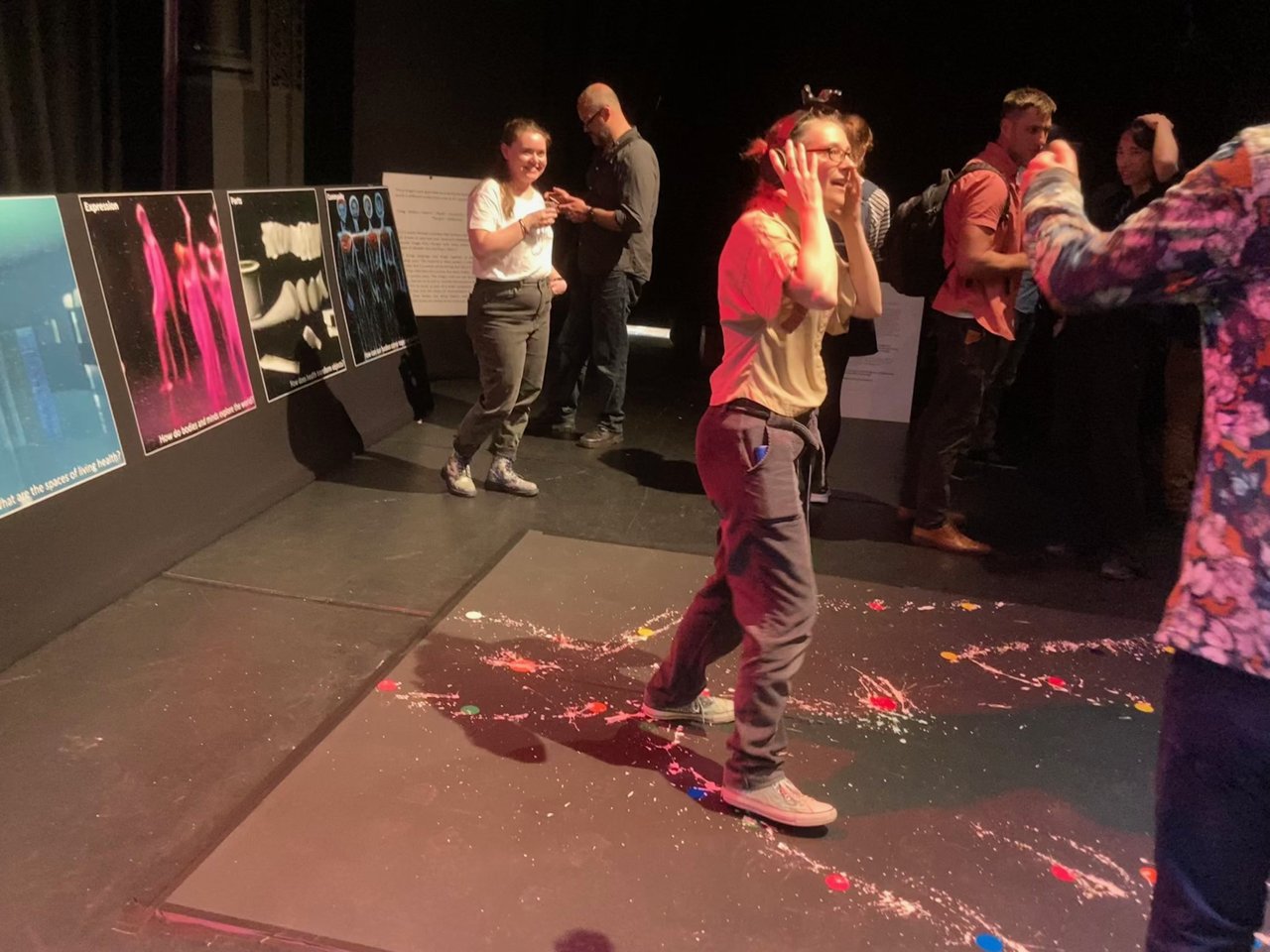
The dancer: movement-driven sound for a live audience
Then it became a performance. For one section of the launch a professional dancer put on the tracked headphones and danced through and around the body – and what she heard, everyone heard, because for that part of the show the audio also went out through the room's speakers.
The system was built to respond to how a body moves, not just where it is. As she quickened, the heartbeat at the centre of the soundscape quickened with her; as she turned, spun and stopped, the other sounds shifted, stretched and settled. The audience watched a dancer and listened to a body answering her – a live duet between a performer and a soundscape, with the choreography as the instrument. For a project asking how technology and bodies shape each other, it was the argument made in three minutes without a word.
Why audio-only immersion matters
Headset VR makes a strong claim on one sense and cuts you off from the room. Audio-only immersion does the opposite: it can be shared, it works for people who can't or won't wear a headset, it's accessible to blind and partially sighted visitors by default, and it leaves people able to see and talk to each other. For a project about bodies and how they're studied, letting people keep their own body in the picture was the point.
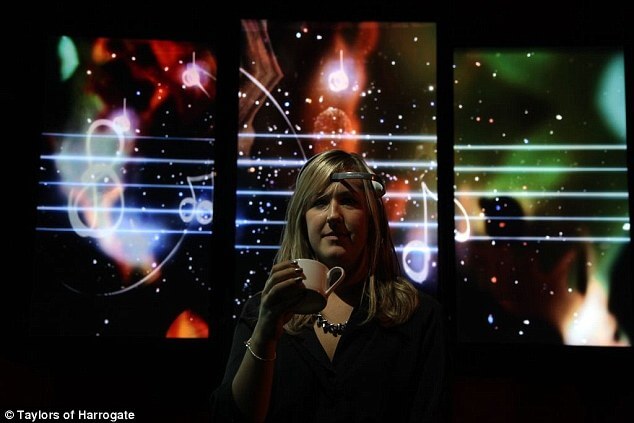
It's an approach we've kept returning to – in Blind Cricket, in our accessibility-first work for Sky, and in the script and spatial sound for The King's Book at Kirkstall Abbey.
Something similar in mind?
A launch, an exhibition, a research project that needs an experience people will remember rather than a stand they'll walk past – we can design and build it, from the tracking hardware to the sound. Tell us a little about it and we'll come back to you.