The iPad painting app we built for David Hockney
Looking for the app? It was made for one artist and isn't publicly available. We do hear from people looking for it - if that's you, tell us.
In short: the iPad paintings David Hockney publicly released from 2018 onward were made in Hockney Brushes - built by us in Leeds to his own specification, and looked after ever since. It isn't publicly available. This page is why it exists, how it turns a painting on a screen a foot wide into a ninety-metre print or a four-storey wall, and where to see the paintings made in it - from the Royal Academy to Salts Mill, where the replay is running now.
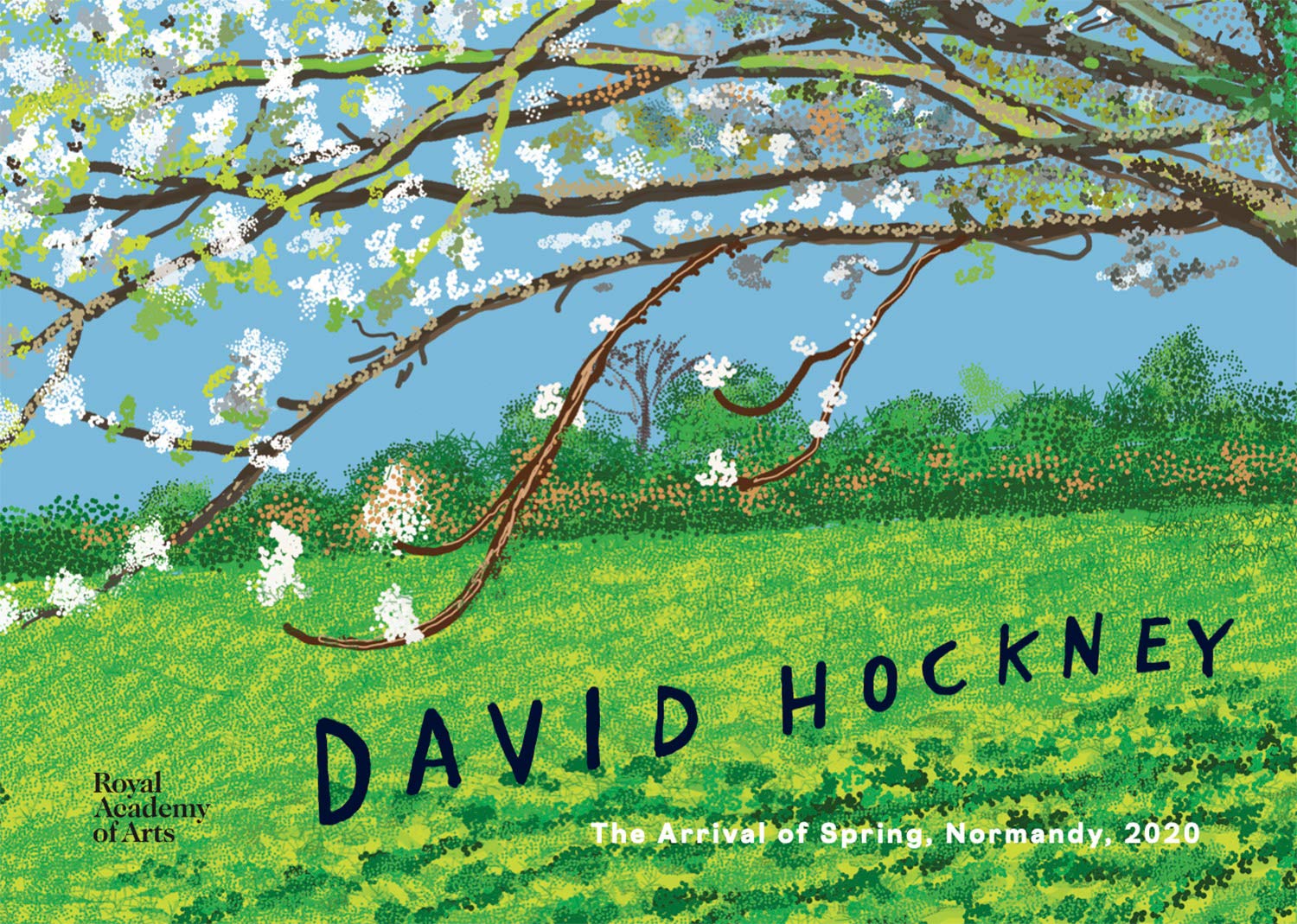
In the spring of 2020, with the world locked down, David Hockney painted the season arriving around his house in Normandy on his iPad - 116 pictures between February and July. He made them in an app built for him by us in Leeds.
Before the app
Our work with the studio began all the way back in 2010, building an internal intranet tool to help them archive his work while he was based in Bridlington. It was a software job done at arm's length - we didn't meet the artist himself until years later, though we caught the occasional glimpse of what he was making: work on a huge scale, all long since shown.
As chance would have it, that was the year the iPad came out. He'd been drawing on his iPhone since 2009 - in Brushes, an app by Steve Sprang, sending friends a flower most mornings - and moved to the bigger screen as soon as there was one. He called it "an endless piece of paper" and talked about its "marvellous flow"; he could draw in the dark, without getting out of bed.
Then Brushes was redesigned, and he stopped using it.
We'd had nothing to do with Brushes up to that point, or with his iPad painting at all - but we'd been building iPad and iOS apps for other clients for years, which is why, in 2017, the studio's call came our way - to a developer they already knew and trusted. He told the story himself in The New Yorker, in 2020:
"Well, I drew on the iPad when it first came out, in 2010. I thought the [original app by Steve Sprang] Brushes was just the best. But then they altered it: they made it a lot worse; it took you longer to find the brushes. And I stopped using it. In 2018, Jonathan Wilkinson, my technical assistant, said he could make a new app with a mathematician in Leeds. It was rather good, and then I got six or seven new brushes custom made..."
- David Hockney, The New Yorker, December 2020
Which app, when
2009–2017 Brushes, by Steve Sprang – on iPhone from 2009, iPad from 2010. Open-sourced in 2013; off the App Store by 2015.
2018 onwards Hockney Brushes, built to his specification by Reflex Arc, Leeds – every iPad painting he publicly released from 2018 was made in it, including the Normandy paintings and the flowers. The replay films come from those same files. Not publicly available.
Not the App Store app Hockney Brushes is a separate, bespoke app, unrelated to the one sold under the Brushes name on the App Store today, which is by a different developer.
Here for the app itself? It isn't publicly available, but you can tell us you'd want it – it takes one tap.
Questions people ask
What did David Hockney paint with?
The iPad is one strand of a much longer practice. He painted in oil and acrylic on canvas, in watercolour, charcoal, coloured pencil and ink, made the photographic collages he called joiners, and designed for the opera stage – and the iPad never replaced any of it. He painted the Normandy spring digitally in 2020 and returned to the same landscape in oil. This page covers the digital strand only, his iPad art: the app he painted with from 2018, and what it took to get a picture made on a screen a foot wide onto a gallery wall.
How did David Hockney paint on the iPad, and what did he use?
With his hand, straight onto the screen. He began on an iPhone in 2009, drawing with his thumb and sending friends a flower most mornings, and moved to the iPad as soon as there was one in 2010 – “an endless piece of paper”, as he called it. For years he drew with a finger or a stylus, and used an Apple Pencil once that was an option. He often worked early and in bed, in the dark, because a lit screen needs no lamp.
From 2018 he painted in Hockney Brushes, with layers and the extra brushes he designed himself and we built for him. Underneath, the app stored each painting as strokes rather than as a flattened bitmap, which is why it can be replayed mark by mark, in the order he made it, and why one made on a screen a foot wide can become a 90-metre print or a four-storey wall without a single mark going soft.
Did David Hockney use Procreate?
Not for any of the work on this page. Every iPad painting he publicly released from 2018 on – the Normandy spring, the flowers, A Year in Normandie, the Moon Room – was made in Hockney Brushes, built for him by us. Before that he used Steve Sprang's original Brushes. You'll see it stated here and there online that he worked in Procreate; we can categorically say the published paintings those pieces show were made in Hockney Brushes.
What app did David Hockney use on his iPad?
Hockney Brushes, from 2018 onwards. It isn't on the public App Store and never has been; it was made for one artist. The app sold as "Brushes" on the App Store today is by a different developer and isn't the one he used. Whether you've seen it called his painting app, his drawing app or his art app, it's the same one: Hockney Brushes, built for him by us.
What iPad did he use?
An iPad Pro, in later years – though we never specified the hardware, and he had used whatever iPad was current since 2010. The app has never needed anything special: it runs on a standard iPad. Screen size was never the point either, because the stroke data is re-rendered at whatever size a show needs – 16k and beyond for print, 4k-plus for the films of each painting drawing itself. The larger screen simply gave him more room to work on.
Who is the “mathematician in Leeds” David Hockney talked about?
Richard England of Reflex Arc, who built Hockney Brushes – though he’s a software developer rather than a mathematician. The phrase was Hockney’s own: in The New Yorker in 2020 he recalled his technical assistant, Jonathan Wilkinson, saying he “could make a new app with a mathematician in Leeds”, and he used it again in a Sky Arts documentary series in 2023. The catalogue for his 2023 Tokyo exhibition called him, more accurately, “the developer Richard England”, and in Spring Cannot Be Cancelled, Hockney’s book with Martin Gayford, he’s “a man in Leeds”.
Can I download Hockney Brushes?
No. It was made for David Hockney and his studio and isn't publicly available. We do hear from people looking for it – if that's you, tell us.
Where can I see the iPad paintings?
Salts Mill in Saltaire is showing 20 Flowers for 2025 and Some Bigger Pictures until January 2027, free to walk in, and the Sunley Window at Turner Contemporary in Margate runs until 1 November 2026. Bigger & Closer is still touring: it’s at BASE Digital Art Center in Shenzhen until 30 May 2027, and at Carriageworks in Sydney from 22 October 2026 to 7 February 2027. The full list of shows since 2020 is below.
Would you use Hockney Brushes if you could? Let us know – one tap, or leave your email in case that ever changes.
Hockney Brushes, 2018
Most of the work of building Hockney Brushes was done in early 2018. The brief was simple to say and hard to do: give him back the thing he'd lost, and make it his. We built Hockney Brushes with the artist and his assistants, starting from Sprang's open-source release of Brushes, and shaping it to the way he liked to work - down to brushes he designed himself and we built for him.
The open-source release was the later Brushes - the version he'd gone off. What we were replacing, in spirit, were two older apps that were never open-sourced: the original Brushes he'd loved, and Brushes Viewer, a Mac-only app the studio had used to turn its files into videos and larger images. We never had the code for either, so the new app restored what they did - to a point, not as a copy - aiming to recover the directness of the earlier workflow. Simpler, quicker, fewer things in the way. Then to give him what he'd wanted and never had - his own brushes first, then tools and a workflow shaped around him, and in time everything it took to get the paintings off the iPad in whatever form a show needed - without ever moving the things he'd already put his hand to. One of the practical changes was that his brushes simply stayed in the palette, ready to use, each with a live preview of the mark it would make on the canvas - no menus to go through to create, store or find them.
Underneath, each painting is stored as strokes rather than as a flattened bitmap. A painting made on a screen a foot wide carries everything needed to draw it again at any size, and to replay it being made, mark by mark. The replay wasn't our idea - Brushes could already play a drawing back, and he'd been showing his being made since 2011 - but we rebuilt it exactly as he liked it, and it became the thing everything else was built on.
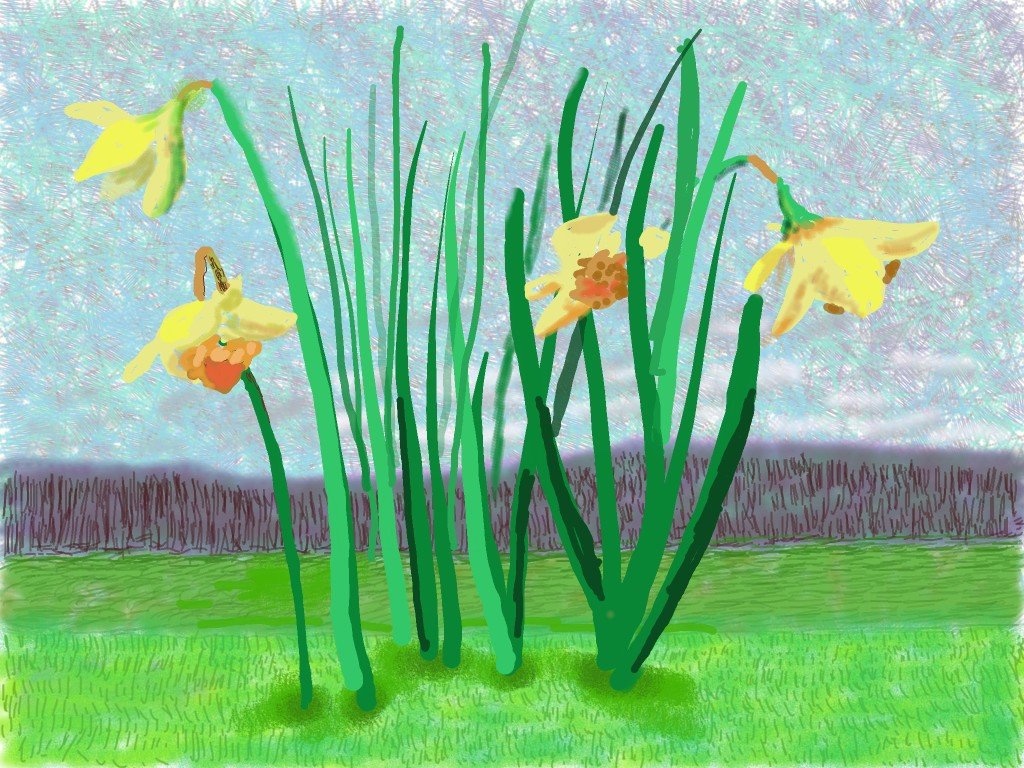
The spring paintings, 2020
Many of the spring paintings – iPad drawings of the Normandy spring as it arrived – reached us by email, often one a day, sent direct from the artist in Normandy. A new Hockney piece in the inbox brightened our mornings through the first dark months of the pandemic.
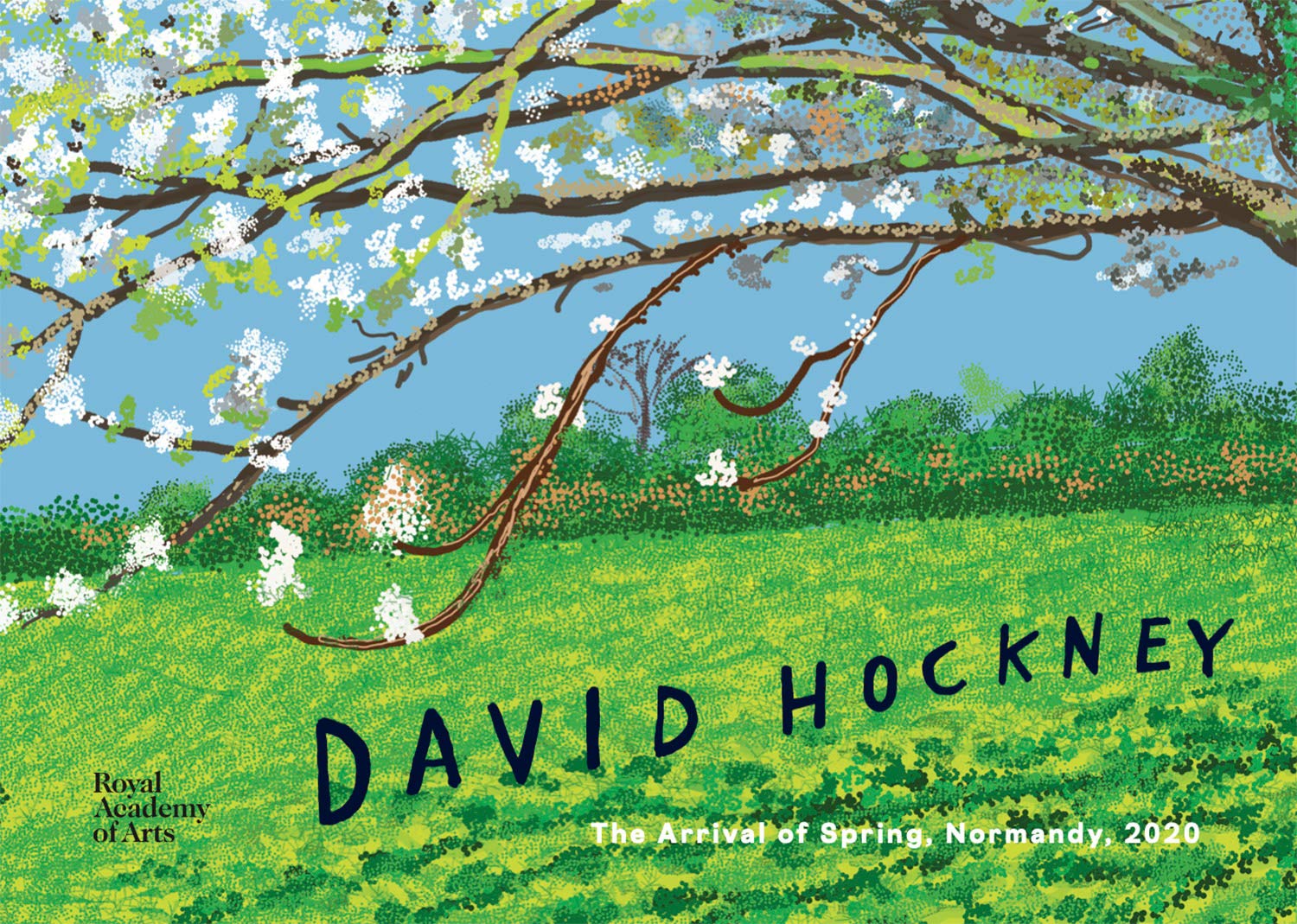
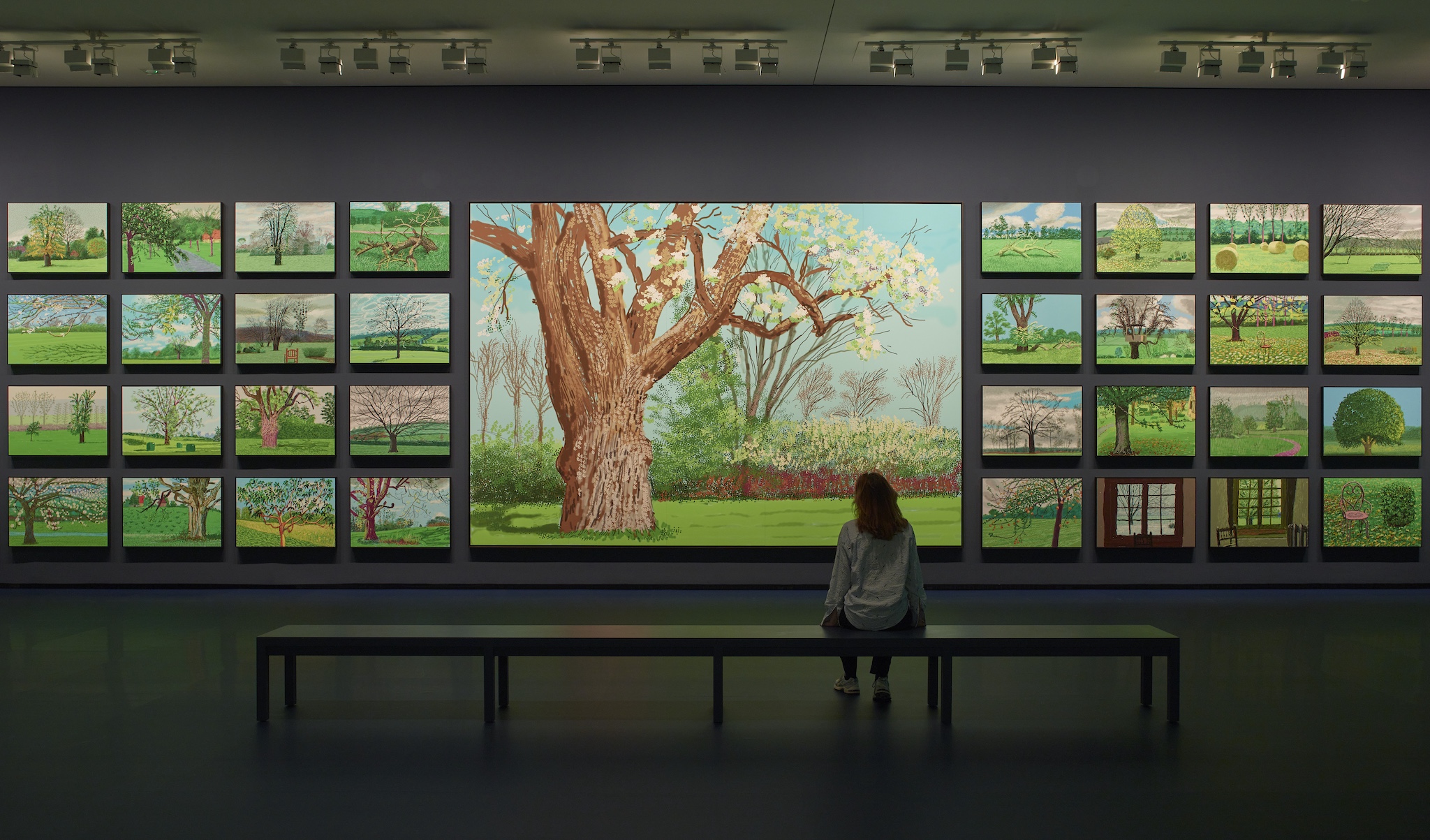
They made headlines around the world when he released a few to the media - here's the BBC's piece from the time, "a respite from the news". A year later, 116 of them were on the walls of the Royal Academy as The Arrival of Spring, Normandy, 2020, every one made and exported from the app. Here's the RA's virtual tour:
For that show the studio asked us for one more thing: an AR element for the catalogue. The official Hockney AR app, for iOS and Android, put the paintings in the room with you.
At scale, 2021
From then on the job was mostly about size. The studio needed the iPad paintings as prints far larger than the screen they were made on, as films of each one being painted, and eventually as installations the size of buildings. Because the app keeps every stroke, enlarging a painting doesn't mean stretching its pixels. The software paints it again at the new size - each of his strokes, in the order he made them, with the same brushes - as if the brush in his hand had been scaled up to the size of the wall. That's why the marks stay crisp at ninety metres, where a stretched image would go soft. The stitched large-format exports and the video rendering run on Apple's Metal - at 16k and beyond for print, and as 4k-plus video of a painting drawing itself from an empty canvas.
The first real test was A Year in Normandie: some of the 220 iPad paintings he made in 2020, joined into a single frieze, printed on paper, 90 metres (295 feet) long - his largest work. It opened at the Musée de l'Orangerie in Paris in 2021 and has since been shown at Salts Mill, Bayeux, Museum Würth, Tokyo and the Serpentine. The studio did the joining, with alignment tools we added to the app for it; our part was the re-rendering that kept every mark clean at that size, and the exhibition notes had this to say about Richard England's role in it:
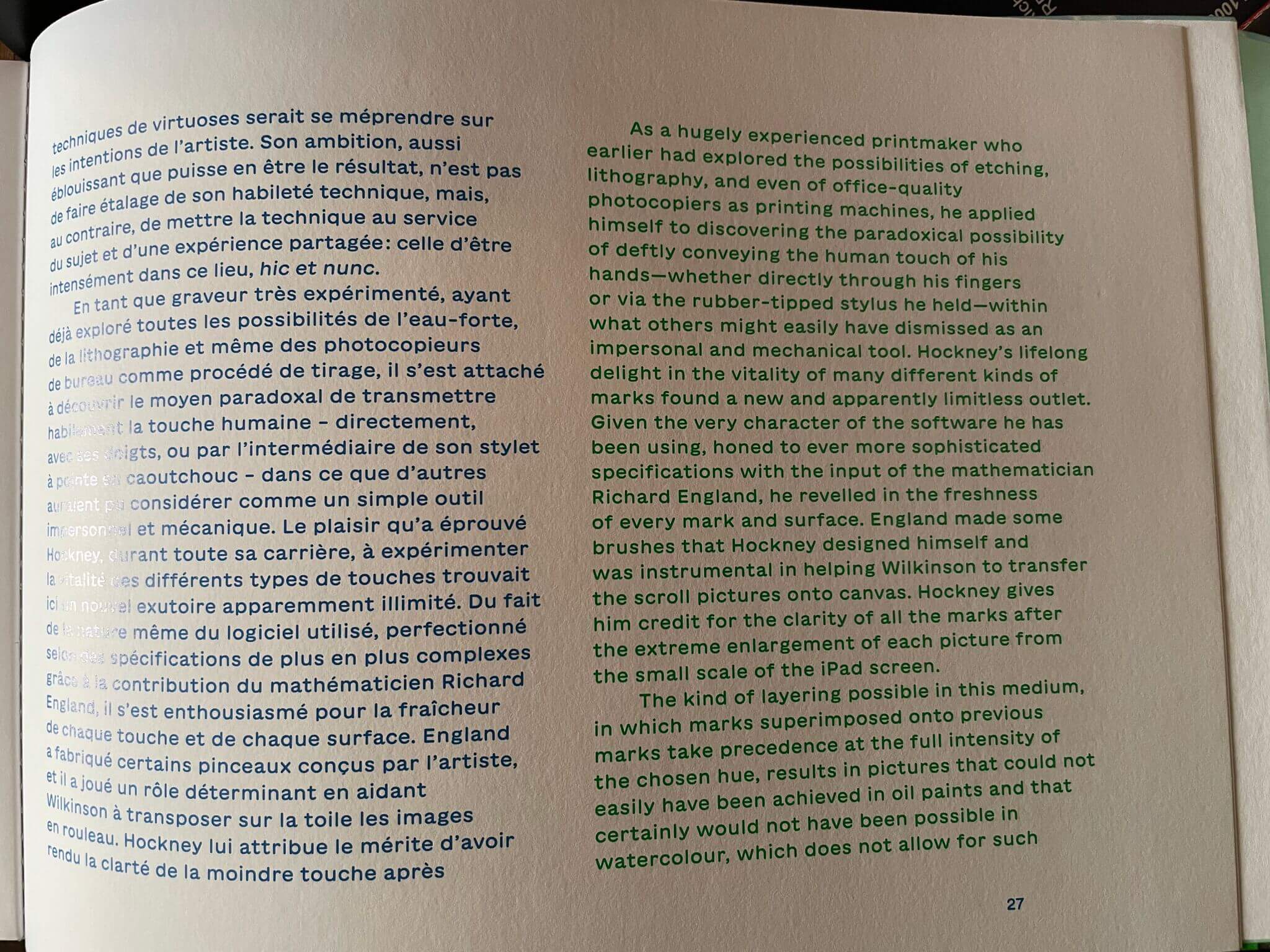
"Given the very character of the software he has been using, honed to ever more sophisticated specifications with the input of... Richard England, he revelled in the freshness of every mark and surface. England made some brushes that Hockney designed himself and was instrumental in helping [Jonathan] Wilkinson to transfer the scroll pictures on to canvas. Hockney gives him credit for the clarity of all the marks after the extreme enlargement of each picture from the small scale of the iPad screen."
- A Year in Normandie, exhibition notes
"The clarity of all the marks after the extreme enlargement" is the stroke data doing its job. Here's the first half of the piece at Salts Mill, to give a sense of the scale:
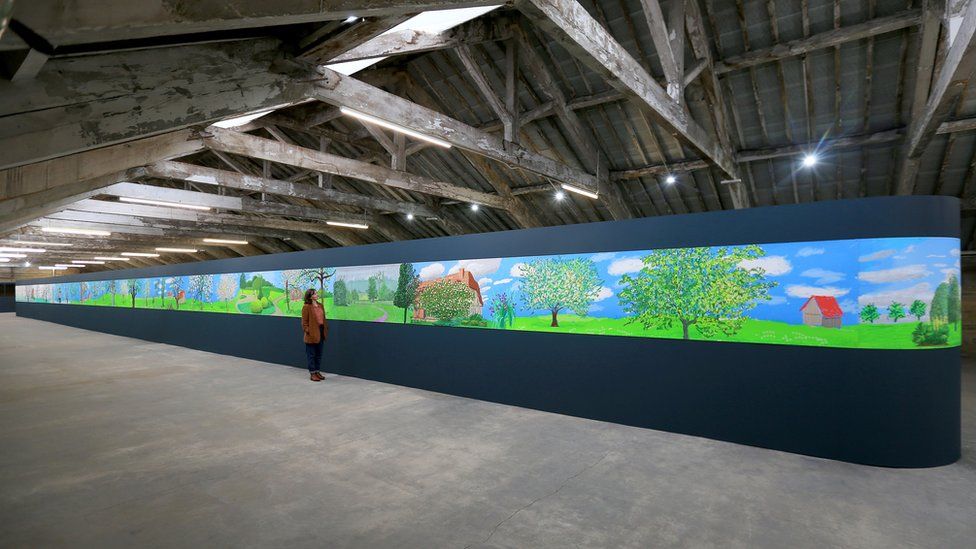
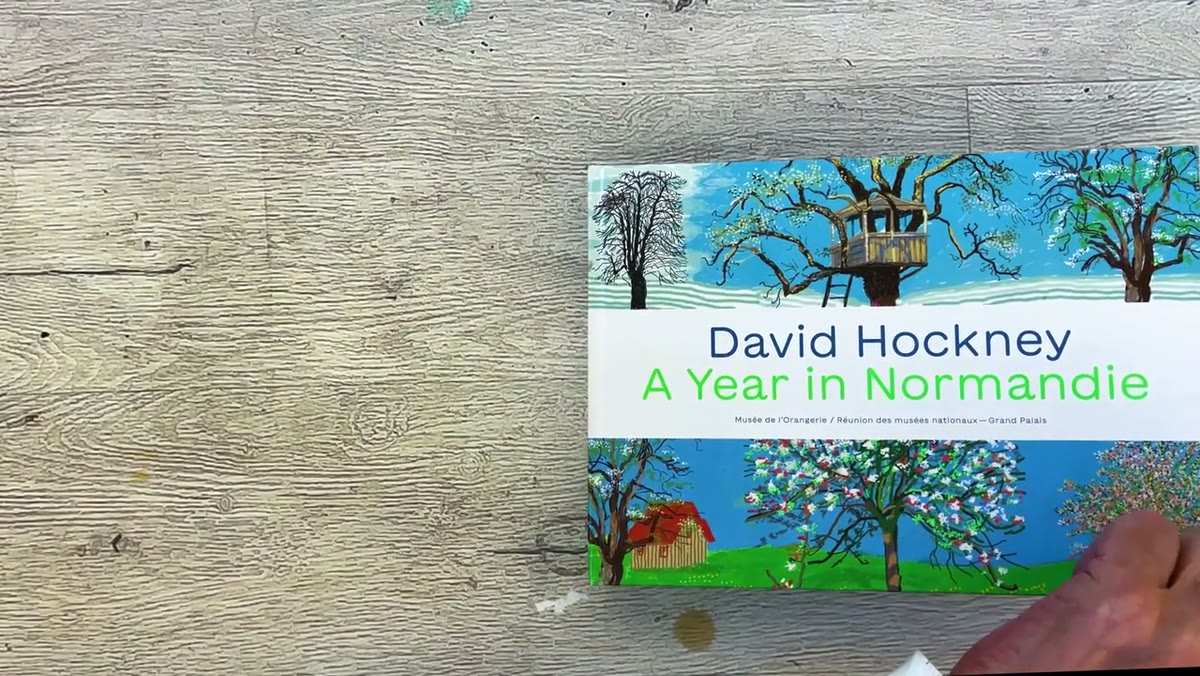
The catalogue itself folds out to 17 metres. Still from the page-by-page video at hockney.com, where you can watch the whole thing unfold. © David Hockney.
Into the room, 2023 onwards
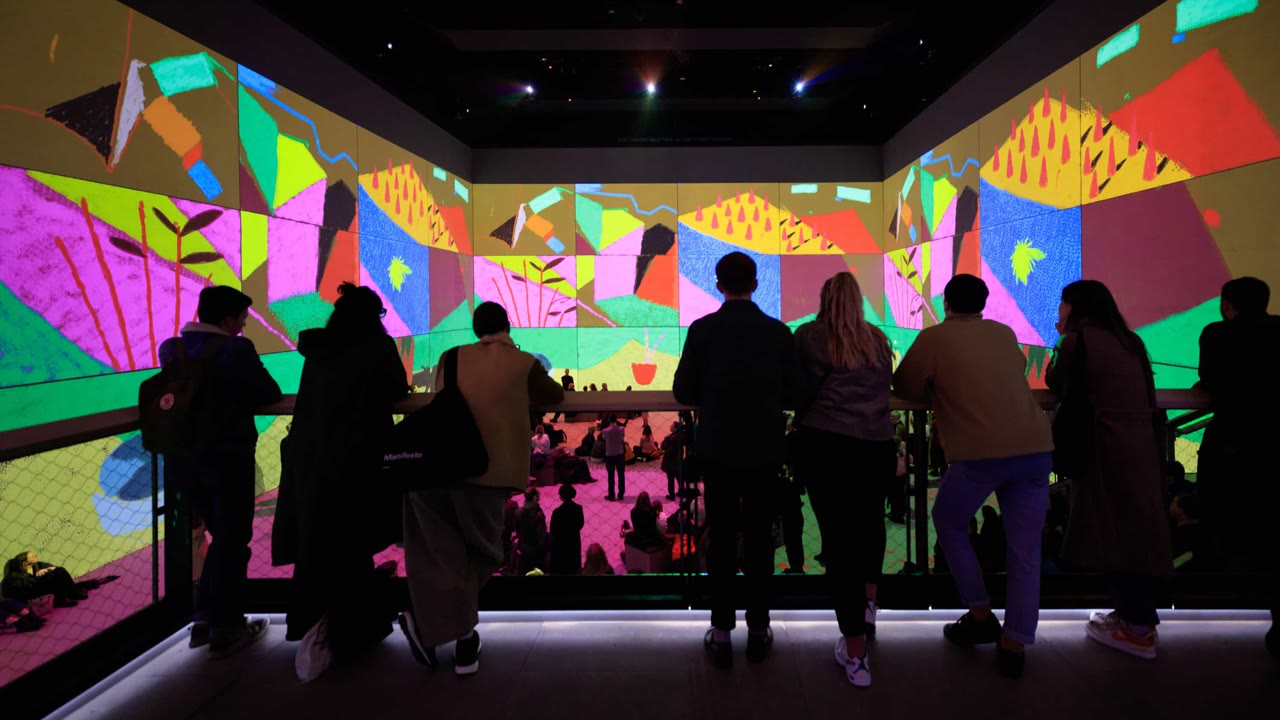
For Bigger & Closer (not smaller & further away), Lightroom's inaugural show in King's Cross in 2023, we added a grid-composition tool for building the multi-panel pieces, and batch export of high-resolution video tiles so that each painting could draw itself across a four-storey wall. The show has since run in London three times, and in Seoul, Manchester, Ulsan, Shanghai, Aranya, Singapore and Shenzhen.
A visualisation of the exhibition.
"You can watch the whole drawing being made. It plays back every mark you did. It's like looking over someone's shoulder to see them draw, and people always love doing that with an artist, don't they?"
- David Hockney, on Bigger & Closer, February 2023
The Guardian's photo essay on the show gives a good sense of the room.
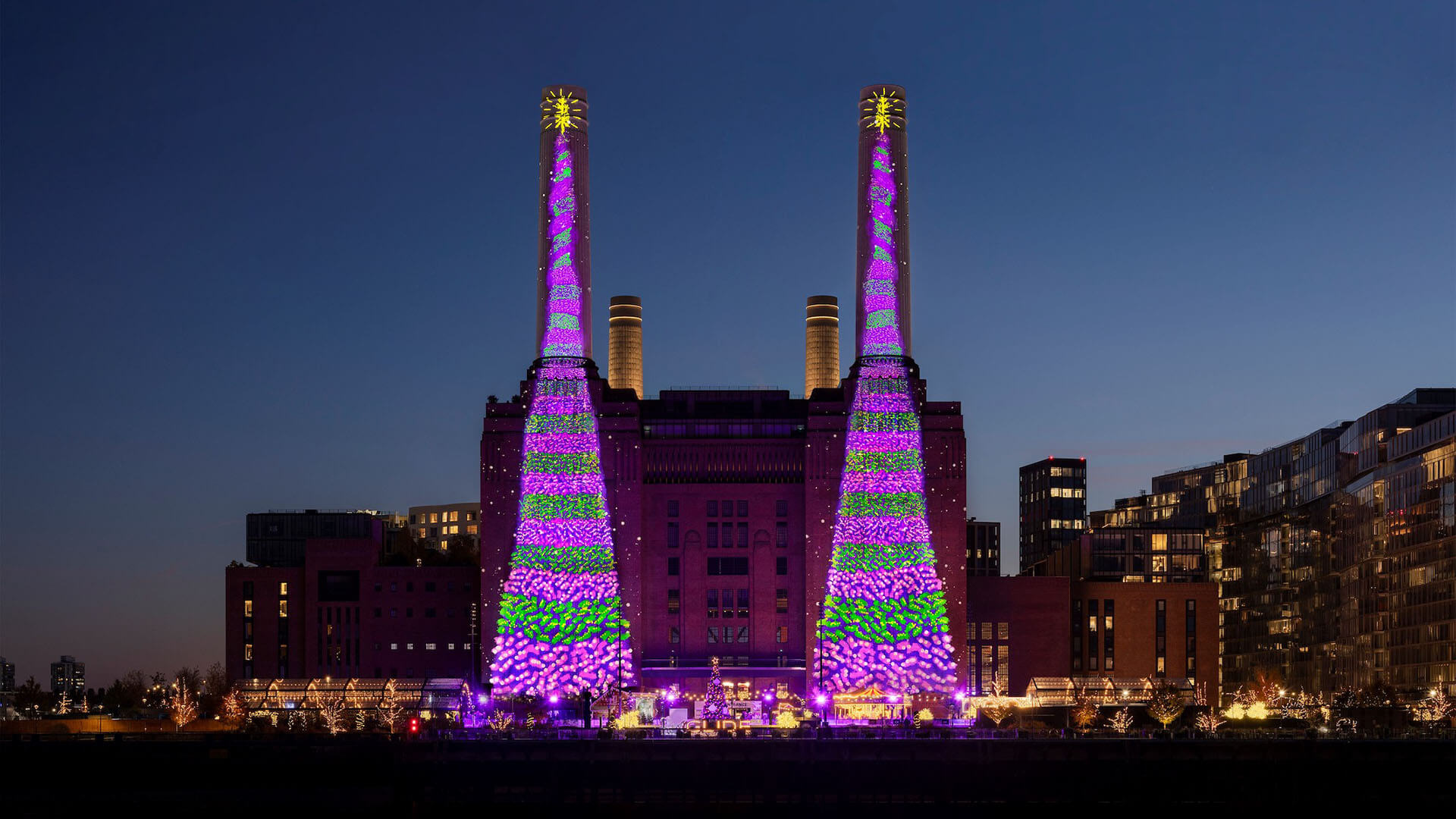
The same tooling went on to put Bigger Christmas Trees across the face of Battersea Power Station, Apple's UK headquarters, and into David Hockney 25 at the Fondation Louis Vuitton in 2025, the largest exhibition of his work ever staged - including its Moon Room, fifteen iPad paintings of the night sky over Normandy, which went on to Galerie Lelong in Paris, Pace in New York and Gray in Chicago through 2026.
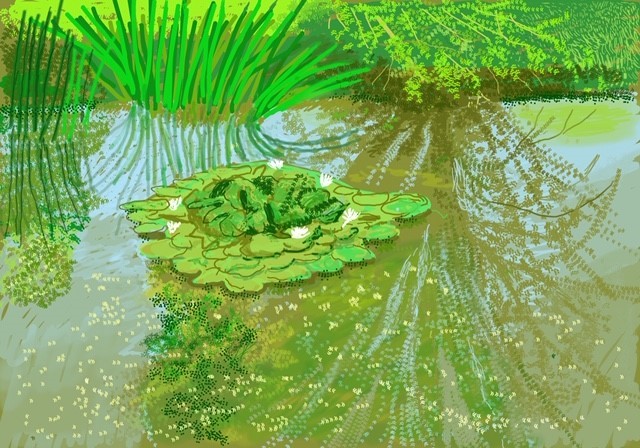
Closer to home, Salts Mill in Saltaire is showing 20 Flowers for 2025 and Some Bigger Pictures until January 2027 - the twenty iPad flower paintings, and a six-screen installation of a water-lily painting from June 2021 drawing itself, brushstroke by brushstroke. Free to walk in and watch.
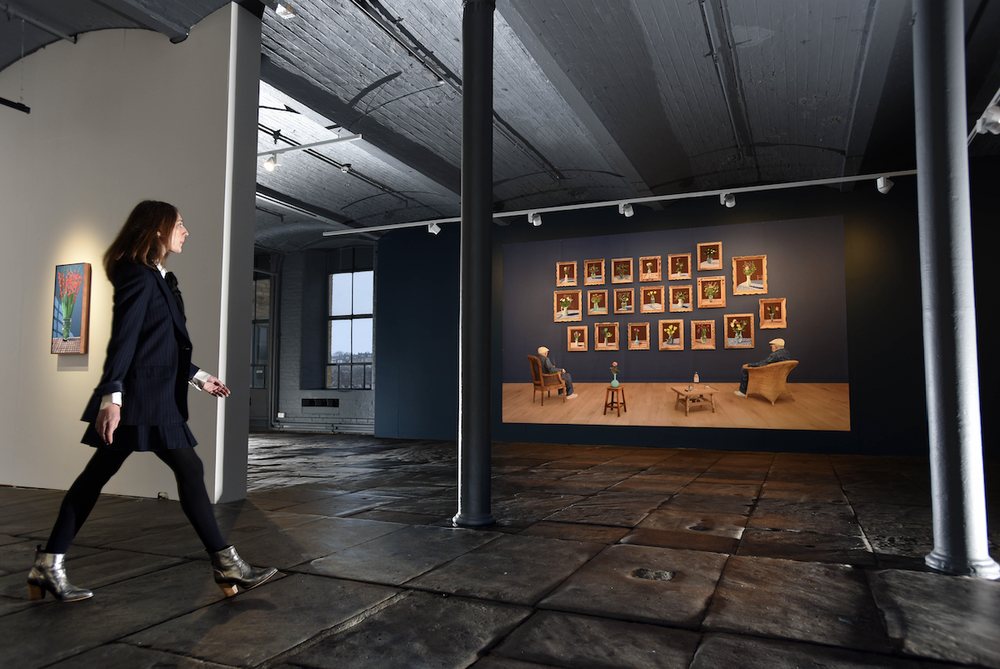
20 Flowers for 2025 and Some Bigger Pictures, Salts Mill, Saltaire. Photo: Salts Mill.
Most recently, in the spring of 2026, a Normandy sunrise he'd painted on the iPad in 2020 became the Sunley Window at Turner Contemporary in Margate: seven metres by ten, filling the gallery's floor-to-ceiling window over the seafront, lit every evening so the real sky and light merge with the work through the glass. It was also the largest single export the tooling had handled to date.
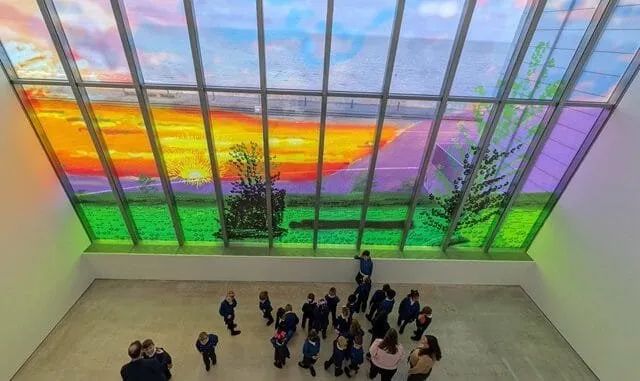
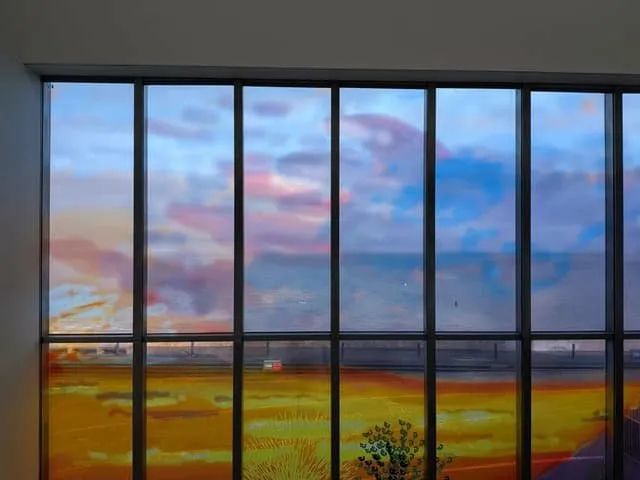
Sunley Window, Turner Contemporary, Margate, 2026. Photos: The Isle of Thanet News / Turner Contemporary.
Where the work has gone
Since 2020, paintings made in the app have been shown in all of these places. By body of work:
- The Arrival of Spring, Normandy, 2020 - Galerie Lelong, Paris; Gray, New York; L.A. Louver; Pace, East Hampton (2020-21) · Royal Academy of Arts, London (2021) · Bozar, Brussels (2021-22) · Sakıp Sabancı Museum, Istanbul (2022) · Art Institute of Chicago (2022-23)
- A Year in Normandie - Musée de l'Orangerie, Paris (2021-22) · Salts Mill, Saltaire (2022-23) · Bayeux Museum (2022-23) · Museum Würth, Künzelsau (2023) · Museum of Contemporary Art Tokyo (2023) · Serpentine North, London (2026)
- 20 Flowers and Some Bigger Pictures - Annely Juda, London; Galerie Lelong, Paris; Gray, Chicago; L.A. Louver (2022) · Pace, New York (2023) · Salts Mill, Saltaire, as 20 Flowers for 2025 (2025 to January 2027)
- Bigger & Closer (not smaller & further away) - Lightroom, London (2023, 2024, 2025) · Lightroom Seoul (2023-24) · Aviva Studios, Manchester (2024-25, 2025-26) · Ulsan (2025) · Shanghai (2025) · Aranya (2025-26) · Singapore (2026) · Shenzhen (2026-27) · Sydney (2026-27)
- Bigger Christmas Trees - Battersea Power Station, London (2023)
- David Hockney 25 - Fondation Louis Vuitton, Paris (2025)
- The Moon Room - Fondation Louis Vuitton, Paris (2025) · Galerie Lelong, Paris · Pace, New York · Gray, Chicago (2026)
- Sunley Window - Turner Contemporary, Margate (April-November 2026)
Writing about the Serpentine show, UnHerd noted that we “designed special virtual brushes for Hockney, one of which was designed to put down bursts of dots in a pointilliste style.”
Finally, a favourite page from one of our copies of the catalogue.
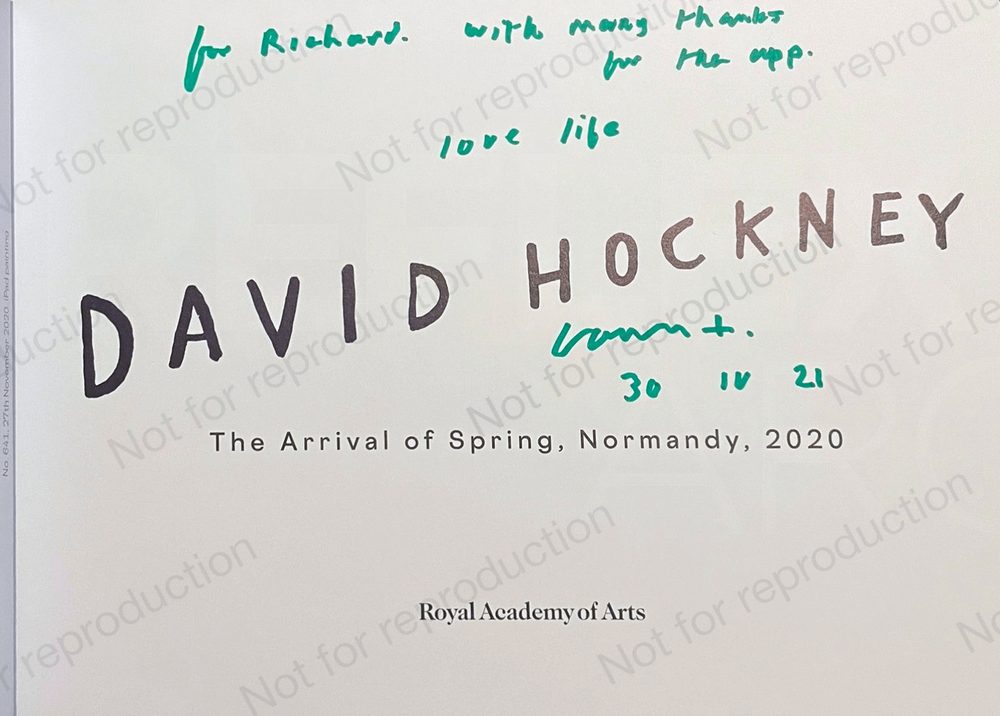
Catalogue for The Arrival of Spring, Normandy, 2020 (Royal Academy of Arts, 2021).
Our pleasure.
Acknowledgements
Thanks to Steve Sprang, creator of the original Brushes app - his open-source release of Brushes informed the early development of this work, and set the standard for the brush feel the artist loved.
The app we made for David Hockney differs considerably from any version of Brushes that has been on the App Store, and is not available to the public. If you've come looking for it, tell us below.
Artwork rights: David Hockney artworks shown for documentation of Reflex Arc’s project history only, © David Hockney / the David Hockney Foundation. No licensing available via Reflex Arc.
Interested in the app?
Hockney Brushes was built for one artist, to his specifications, and it isn't publicly available. Even so, a lot of people arrive at this page looking for it, and we'd like to know how many.
Counted – thank you. If you'd like to hear should anything change, there's a form below; if not, that's fine.
There's nothing to announce. If you'd like to hear should that ever change, leave your email. And if you've a question about the app, or about the paintings, ask it here – we'll answer if we can. We'll use your address for nothing else.
Related
Large-scale immersive
Real-time and XR

Gallery